
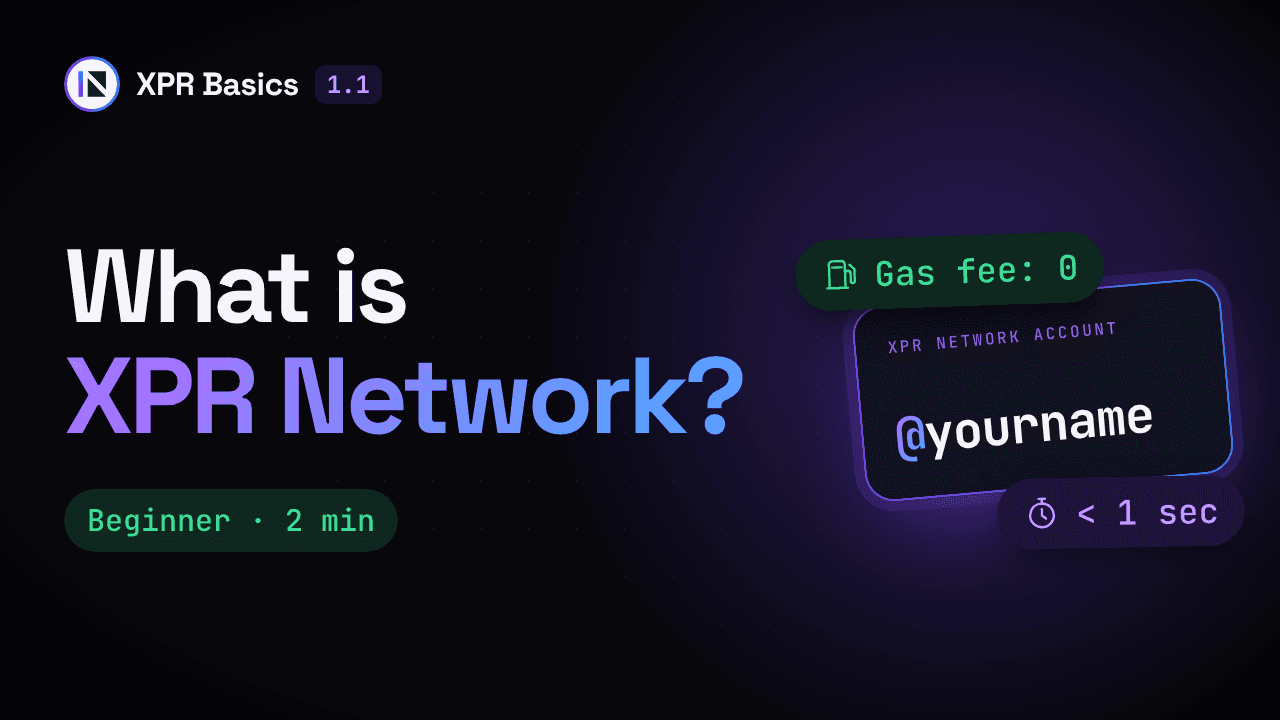
XPR Network is a layer 1 blockchain, formerly known as Proton. It's built for payments and everyday apps, so the things that usually make crypto hard, like long wallet addresses, a fee on every transaction and long waits, are designed out from the start.
This guide covers the same ground as the XPR Basics 1.1 video.
A layer 1 blockchain
Layer 1 means XPR Network is its own blockchain. It isn't built on top of another network. It processes and records its transactions itself.
Readable account names
On most blockchains, an address is a long string like 0x7a3f…d61C. Type one character wrong and the funds go somewhere else.
On XPR Network, every account has a readable name, like @yourname. You share it the way you share a username, and there's far less room for a costly typo.
More: Sending and Receiving XPR: How to Use @names and Zero-Fee Transfers
No gas fees on everyday transactions
On many blockchains, every transaction costs a gas fee. On XPR Network, everyday transactions have no gas fees, so even a small transfer arrives in full. How the network covers its costs gets its own XPR Basics episode later in the series.
Fast
Most transactions confirm in under a second, so payments feel instant.
The WebAuth wallet
To use the network, you need a wallet. The official one is WebAuth, available on iOS, Android and the web. You approve transactions with your phone's security, like your fingerprint or Face ID, and you stay in control of your own keys.
Step by step: Creating a Wallet: Step-by-Step Guide to Setting Up WebAuth Wallet and the XPR Basics 1.2 video.
Who runs the network: Block Producers
XPR holders stake their tokens and vote for Block Producers. The top 21 producers validate transactions and create new blocks. The more XPR you stake, the more your vote counts.
More: Staking XPR: How to Earn Rewards and Support the Network
XPR Hub and this series are made by artwebin, which is itself a Block Producer. This guide doesn't recommend any producer to vote for.
What you can do on XPR Network
- Swap and trade on Metal X, the network's decentralized exchange
- Stake XPR to earn staking rewards
- Lend and borrow on Metal X Lending
- Hold xTokens: wrapped versions of coins like Bitcoin (XBTC) and Ethereum (XETH), backed one to one
Verification
Some features, like swapping and bridging, ask you to verify your identity first. See Identity Verification: How and Why to Get Verified on XPR.
One rule before you start
Never share your private key or recovery phrase. Not with support, not with anyone. Whoever has them controls your account.
In short
- Readable names instead of long addresses
- No gas fees on everyday transactions
- Transactions confirm in under a second
- A wallet you control
XPR Basics is a community tutorial series by artwebin, an XPR Network Block Producer. It is not an official XPR Network resource and nothing here is financial advice. Sources: XPR Network docs, XPR Network Help Center and the XPR Network glossary.