
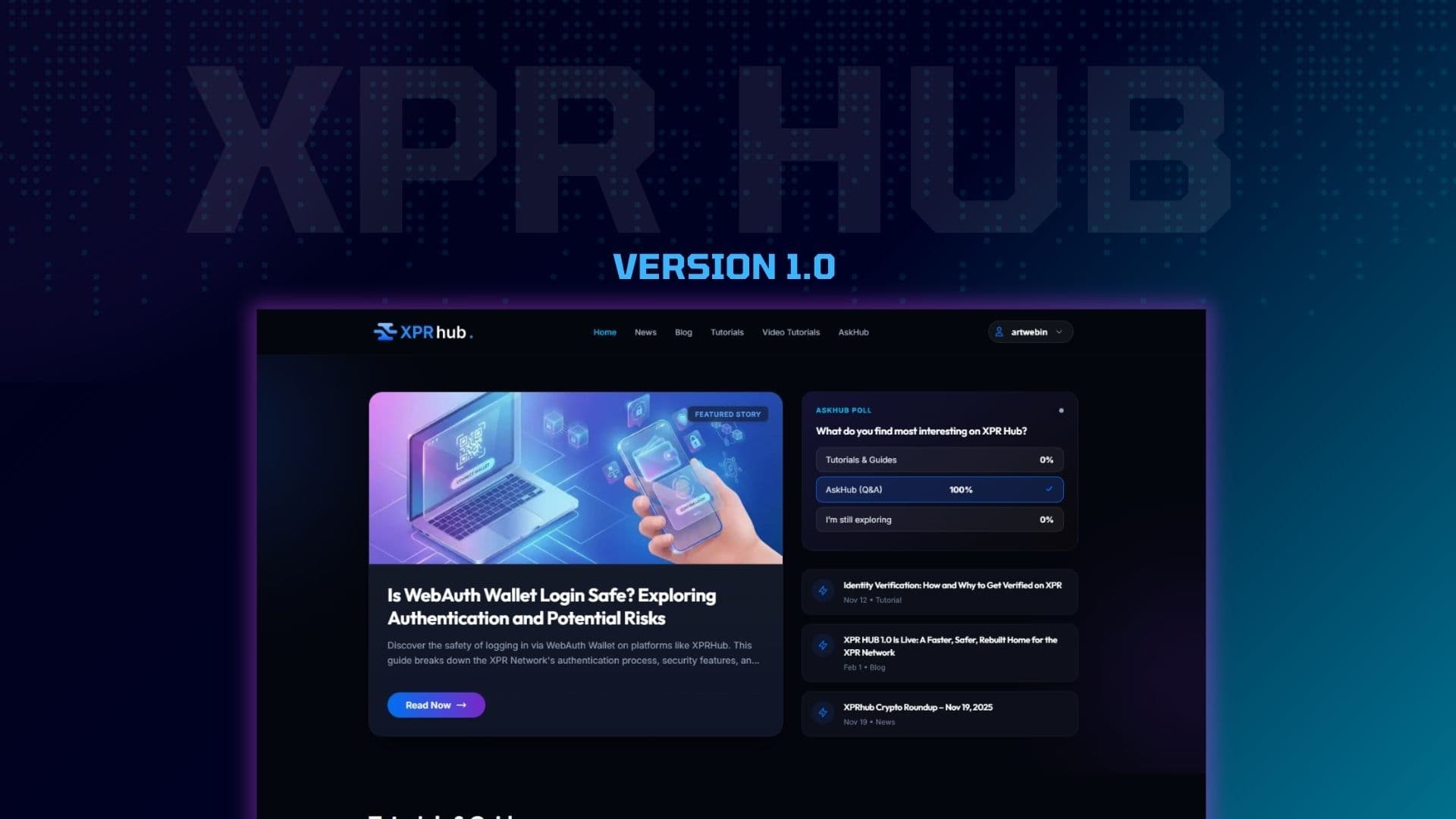
When we launched XPR HUB in beta, the goal was simple: build a real community hub for the XPR Network. A place for tutorials, tools, and AskHub Q&A, built around one idea: if the ecosystem grows, it should be easier for everyone to learn, participate, and contribute.
Since the beta launch, a lot has happened behind the scenes.
Today, I’m happy to say we’re officially moving out of beta and into XPR HUB v1.0.
This is not just a “new theme” or a quick refresh. It’s a full rebuild, focused on performance, security, and a better experience for people who actually use the platform day-to-day.day.
Why a full rebuild?
The beta version did its job. It helped us validate the idea quickly and was great for testing. But after that, the next step was obvious: rebuild XPR HUB on a modern stack that gives us more control over speed, user experience, and future features.
So we moved to Next.js, which lets us treat XPR HUB less like a “website” and more like a proper web app, while still keeping it content-friendly and easy to expand.
What’s new in v1.0
1) WordPress → Next.js migration (the big one)
XPR HUB is now rebuilt on Next.js. That unlocks:
- more flexibility for custom features
- better control over loading behavior and UI
- a cleaner path for ongoing improvements without fighting platform limitations
2) Noticeably better performance
The new build is designed to feel faster everywhere:
- quicker page loads
- smoother navigation
- less unnecessary bloat
- more room to scale as content and features grow
3) AskHub improvements
AskHub received a major UX upgrade, primarily through a cleaner and more structured design. Everything is now where you expect it, which makes it easier to scan, easier to follow, and quicker to use. On top of that, performance has been improved so the whole experience feels more responsive.
- Better structure and usability
- Cleaner browsing and discovery
- Improved performance and responsiveness
4) Stronger security hardening
Security is not a checkbox feature. With v1.0, the biggest improvement comes from the new architecture: the database, the CMS, and the frontend are no longer sitting in one monolithic setup.
Instead, each layer is separated and protected on its own. That means tighter access control, fewer exposed parts, and a smaller blast radius if anything ever goes wrong.
5) Small design upgrades
You’ll notice a bunch of smaller UI changes that make the site feel cleaner and more consistent.
6) A completely rebuilt Profile page with on-chain data
The Profile page is fully redesigned and now:
- verifies the user properly
- pulls relevant on-chain data
- turns your profile into a useful dashboard, not just an account page
It becomes a place where your account and on-chain activity feel connected in a practical way.
Help test it
If you’ve used XPR HUB before, I’d love for you to:
- browse around like a normal user
- try AskHub
- open your Profile page and test the dashboard
- report anything that feels off, confusing, or broken
Where to send feedback:
- Post it on AskHub (already opened a thread with the title “Feedback for XPR HUB 1.0”)
- or msg me on X (@artwebin)
- or send us an email: [email protected]
What’s next
Version 1.0 is the foundation. From here, the focus is on:
- expanding the Profile dashboard with more useful on-chain context
- making AskHub even better for community-driven knowledge
- shipping new features that bring more real utility to the ecosystem and make the platform more valuable to use day-to-day
Thank you
Building this took a lot of time and stubborn effort, but it’s worth it because the XPR ecosystem needs a strong, community-first hub that’s built to scale.